
Post-signature work begins the moment a contract is signed, and responsibilities shift from agreeing on terms to executing them. Once the ink dries, the real work begins: storing agreements, tracking obligations, monitoring renewal dates, and ensuring every
This is where many businesses start to struggle. Contracts end up scattered across inboxes, shared drives, and personal folders. Renewal reminders rely on disconnected spreadsheets. Important clauses, such as pricing adjustments, notice periods, or termination terms, often surface only after they’ve caused issues. Teams spend more time searching for information than acting on it, leading to repeated manual checks, unclear ownership, and avoidable delays.
A well-planned Salesforce implementation for the post-signature stage provides structure. It makes executed agreements and key contract data available in the same place where sales, customer success, finance, and legal already work. It shifts teams from chasing documents to following through with clarity and accountability. This lays the foundation for everything that follows.
Inside your CRM: How native integration works
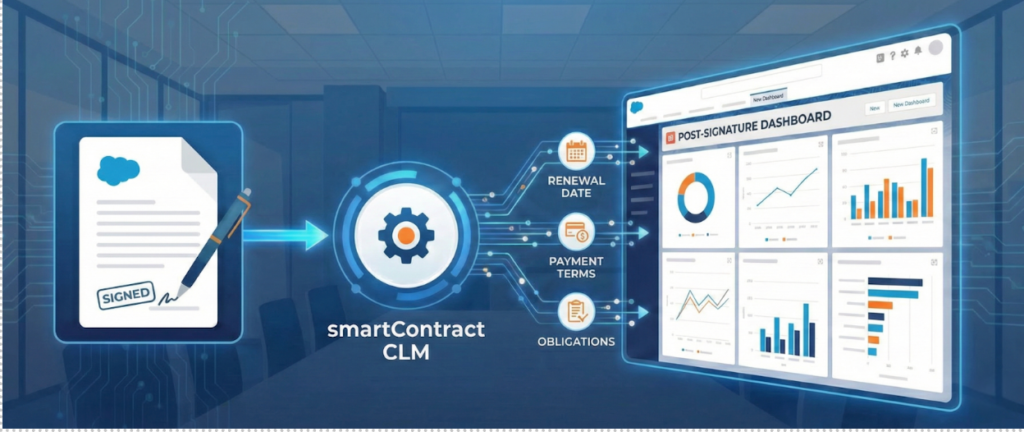
A native CLM connects directly inside Salesforce. It becomes part of the system your teams use every day. It means executed agreements sync automatically with accounts, opportunities, and any standard or custom objects. As a result, every signed contract appears as usable data in Salesforce. You can see contract status, renewal dates, and linked files without switching apps. You can store the PDF in Salesforce or keep it in your CLM repository. Either way, both stay connected through the same integration.
This native setup eliminates context-switching and manual uploads. Sales, customer success, and finance teams all work from the same source of truth. It strengthens your Salesforce implementation for post-signature and makes contract management feel like a natural part of their daily workflow.
Data extraction that powers your Salesforce implementation
After a contract is signed, smartContract CLM processes the executed agreement and extracts the commercial terms teams need for post-signature operations. This includes contract term and effective dates, payment obligations and billing cycles, renewal and opt-out timelines, price-change conditions, and termination notice requirements.
Extraction is most valuable for negotiated or non-standard contracts, where key terms often vary from templates and cannot be reliably captured through manual configuration alone. Each extracted field is mapped directly to Salesforce, ensuring contract data remains structured, searchable, and continuously available on the relevant record. By converting executed agreements into live data, the integration removes manual document review and enables renewals, forecasting, and compliance activities to be managed directly within Salesforce.
Where contract insights appear in Salesforce
Contract data extracted by smartContract CLM is surfaced directly within Salesforce, alongside the records users already work with. Key terms such as renewal conditions, opt-out periods, payment schedules, termination dates, and overall contract duration are displayed next to the agreement file, eliminating the need to search through folders or external systems.
When agreements originate from guided templates, fields remain structurally consistent by design. For negotiated or non-standard contracts, smartContract normalises extracted terms so they can still be tracked and reported accurately. This combination supports reliable reporting, forecasting, and portfolio oversight across the entire contract lifecycle within Salesforce.
Stronger renewals & reporting with Salesforce automation
Post-signature data helps teams track renewals, obligations, and upcoming milestones more reliably. Renewal windows, termination notice periods, and escalation schedules are captured as standardized fields. This enables automated reminders and task creation, allowing teams to act without manual follow-up.
Dashboards highlight renewals due in 3, 6, or 12 months. Obligation fields guide customer success and finance teams in their routine work, making it easier to know what needs attention and when. When cross-functional action is required, teams can move quickly because the exact contract terms are available where they already work. Version history and approval trails provide a clear audit record of changes from drafting to execution.
Together, these capabilities minimize renewal loss. They also make compliance easier to manage, and they give leadership a clear view of contract performance throughout the post-signature stage.
Collaboration, approvals & handoff to signature
Strong collaboration before signature sets the stage for smoother post-signature work. Collaboration and approval workflows help teams review terms, agree on language, and maintain a clear audit trail of changes. Once the terms are final, the agreement is sent for signature, and the completed contract is synced back into Salesforce. All changes, comments, and approval notes stay linked to the same customer or opportunity record, so nothing gets lost in the handoff.
Together, these steps create a unified contract lifecycle in which drafting, review, execution, and follow-through are all visible inside Salesforce. This strengthens your Salesforce implementation for post-signature and ensures clarity from the first draft to the outcome.
Why Salesforce implementation for post-signature matters
Once a contract is signed, new problems often start to show up. Those issues slow teams down, put revenue at risk, and create extra work across the business. A well-built Salesforce implementation after the signature closes that gap and makes contract data reliable. It turns executed agreements into actionable business data and keeps requirements and milestones visible to the teams that need them.
With smartContract as the CLM layer, post-signature processes become predictable and easier to manage. That means teams can find the correct details in Salesforce, see approvals in context, and carry pre-signature decisions forward into execution. The result is a consistent contract process from first draft to long-term account management.
When post-signature activity lives where your teams already work, nothing slips through the cracks. Renewals stay on schedule, obligations remain on track, and businesses gain the visibility needed to protect customer value. This clarity keeps operations steady and ensures contracts continue to deliver value long after the ink dries.
FAQs
It’s the work that begins after signing: managing renewals, obligations, and milestones, and ensuring the contract is executed correctly.
Contract data often sits in emails, folders, and spreadsheets, making key dates easy to miss and slowing teams down.
It centralizes executed agreements and contract data in Salesforce, giving teams a single place to track renewals, obligations, and compliance with far less manual work.
smartContract extracts key contract terms, keeps approval history, and links version details to the proper Salesforce record so teams always see accurate information.
Fewer missed renewals, clearer compliance, faster account management, and more reliable visibility across the entire customer lifecycle.