
Every business runs on agreements, but managing those agreements is not always simple. Contracts move through several stages, from creating the first draft to reviewing terms, making changes, getting approvals, and finally signing and managing them over time.
Contract lifecycle management (CLM) is the process of managing a contract from request to signing, tracking it through renewal and updates in a clear, structured way. In simple terms, it helps you understand how a contract moves step by step, so nothing gets missed. When businesses follow a defined contract management process, they can move contracts faster, stay aligned, and avoid delays. AI-powered contract management improves this further by automating tasks, extracting key information, and providing real-time insights, making the process easier to follow, faster to complete, and more reliable for everyday use.
When businesses do not manage contracts properly, teams can lose track of progress, miss deadlines, or struggle to stay aligned. It often leads to delays, compliance risks, and missed opportunities.
In this article, we will break down how contracts move step by step, explore how AI in CLM can make this process easier, and show how smartContract CLM helps businesses manage contracts more efficiently.
How the AI-powered contract management process works
In businesses across industries, contracts usually follow a clear path from start to finish. These steps show how a basic request becomes a signed and active agreement. When teams understand this flow, they know what comes next, which keeps the contract management process smooth and easier to control.
The stages of the contract lifecycle management process usually include:
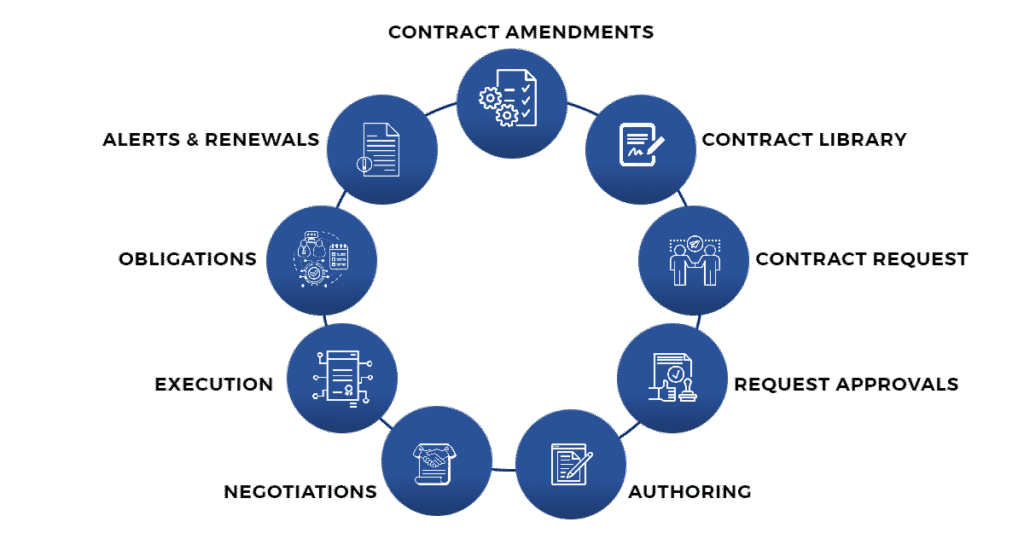
- Contract library:
Teams store signed contracts in one central place. This makes it easy to find them later without having to search through emails or files. Anyone can quickly check details or refer back to the contract whenever needed.
- Contract request:
The process begins when someone in the business needs a contract. It could be for working with a vendor, signing a client, or starting a partnership. The person raising the request shares key details, such as the contract’s purpose, who is involved, and the expected outcome. This sets a clear starting point for everyone involved.
- Request approvals:
After both parties agree on the terms, the contract undergoes internal checks. Legal, finance, or business teams review it based on their role. They confirm everything looks right before moving forward. This step helps catch issues early.
- Authoring:
Once teams understand the need, they draft the contract. It includes details like roles, timelines, payment terms, and key obligations. Legal and business teams work together to ensure everything remains accurate and practical. A clear practical draft keeps the next steps simple and avoids confusion.
- Negotiations:
Teams share the draft with the other party. Both sides review it, suggest changes, and discuss terms until they reach an agreement that works for everyone.
- Signing and execution:
After approvals, both parties sign the contract. This makes the agreement official and sets clear expectations for both sides going forward.
- Obligation management:
Once the contract is in effect, both parties fulfill their obligations. Teams track tasks, timelines, and responsibilities to keep everything on track and avoid gaps.
- Alerts and renewals:
Contracts include important dates, such as deadlines and renewal timelines. Teams track these dates and act at the right time to avoid missed deadlines or unwanted renewals.
- Amendments and updates:
As business needs change, teams update the contract. They review and agree on changes so that the contracts remain clear, accurate, and useful.
How CLM software makes contract management easier
Once contracts start moving across teams, manual management can slow things down and create gaps. AI-powered CLM software helps businesses manage contracts more efficiently, allowing teams to move faster and stay in control without extra effort by bringing intelligence into everyday contract workflows.
Here is how a CLM solution can help your business:
- Saves time on everyday work:
Teams often spend time searching for contracts, checking the latest version, or following up on approvals. CLM software uses AI to quickly show up the right contracts, identify the latest version, and organize information so teams can find what they need without delay.
- Reduces manual work through automation:
Teams often repeat tasks such as sending approvals, setting reminders, and tracking progress. CLM software automates these workflows, while AI further reduces effort by handling routine actions and guiding next steps. As a result, teams can now focus on higher-value work.
- Gives better visibility across teams:
Teams can see exactly where each contract stands at any moment. AI adds context to this visibility by highlighting key updates, flagging changes, and helping teams understand what needs attention, so work keeps moving without confusion.
- Helps avoid missed deadlines:
Contracts include key dates like approvals, renewals, and milestones. CLM software sends timely alerts, while AI identifies which deadlines matter most and brings them to attention, helping teams act before issues arise.
- Improves accuracy and reduces errors:
When teams handle contracts manually, mistakes such as using the wrong version or missing steps can occur. CLM software keeps everything structured, while AI helps detect missing terms, inconsistencies, or risks, improving overall accuracy.
- Uses AI to support better decisions:
AI helps teams review contracts more quickly, highlight key terms, and identify risks early. It can also extract key data points and provide insights that support faster, more informed decision-making.
- Simplifies contract management across the business:
CLM tools like smartContract bring these capabilities together in a single system. By combining automation with AI-driven intelligence, businesses can manage contracts with greater control, faster execution, and fewer delays from start to finish.
How smartContract CLM helps the contract management process
As contracts move across teams and continue to grow in number, businesses need a reliable way to manage them without slowing down work. Teams need a system that helps them act quickly, stay on top of responsibilities, and keep contracts moving without gaps.
smartContract CLM helps businesses manage contract processes by bringing all contract activity into one place with AI-powered visibility. Sales teams can move deals forward without waiting for updates, legal teams can review and respond on time, and business teams can stay informed without constant follow-ups. This keeps work moving and helps teams handle contracts without delays.
It also helps teams stay on track as contracts progress. Teams can quickly see what needs attention, act at the right time, and avoid last-minute issues with AI-assisted insights. It improves coordination across teams and helps businesses handle contracts more smoothly in day-to-day work. smartContract CLM supports long-term contract management by helping teams track progress, manage updates, and prepare for renewals. As needs change, teams can easily update contracts and keep them aligned with current business requirements through AI-supported workflows.
In the end, a well-managed contract management process helps businesses make faster decisions, reduce risks, and keep teams working in sync. With the right system in place, teams can handle contracts more efficiently and maintain better control at every stage with AI-powered support.
Ready to simplify your contract management process?
Discover how smartContract CLM helps businesses manage contracts more efficiently, reduce manual work, and stay in control with AI-powered insights.
FAQ's
A contract management process is how businesses handle contracts from start to finish, including drafting, approvals, and tracking. It helps teams manage agreements in a structured, organized way, with AI improving visibility and understanding at each step.
Common contract management challenges include slow approvals, missed deadlines, lack of visibility, and manual processes. These issues can create delays and risks, especially without AI support to detect problems early.
A contract management process becomes more efficient when steps are clearly defined and easy to follow. Using the right tools with AI capabilities helps reduce manual work and move contracts faster.
Contract lifecycle management (CLM) involves managing contracts from creation through renewal. It helps businesses track progress, manage obligations, and stay aligned across teams, with AI improving speed and accuracy.
Contract management software helps businesses automate workflows, centralize contracts, and track obligations in real time. With AI features, efficiency improves, errors are reduced, and contract control is enhanced.